Why Is Process Street the Best for Robust Decisioning Engines?
Your decisioning engine runs on outdated rules and scattered data, which means every approval or policy check creates another manual review.
This forces teams to rebuild the same logic across tools and still risk gaps during audits. By the end of this article you will see exactly how Process Street automates policy enforcement, orchestrates approval workflows, and records compliance evidence in one audit-ready system.
What Is Process Street?
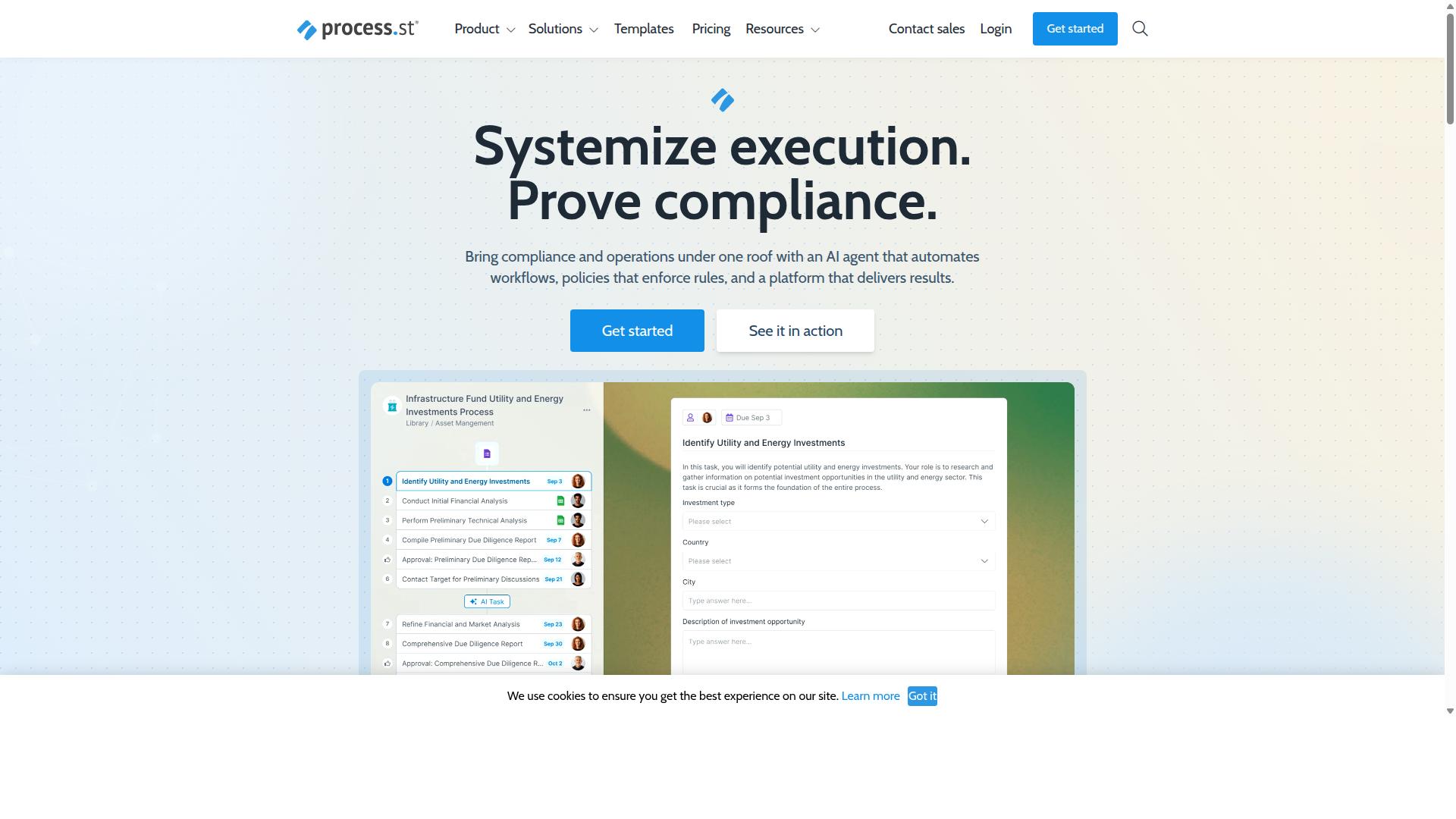
Process Street is a compliance operations platform that automates business processes and enforces policies with audit-ready proof. The platform serves organizations that need consistent decision support across their operations.
Three primary products power the platform. Docs handles document management and policy control. Ops manages workflow automation and process orchestration. Cora functions as an AI compliance and risk agent that supports ongoing monitoring.
Global availability combined with regional data residency options allows organizations to meet local regulatory requirements while maintaining centralized process governance. This structure supports teams that operate across multiple jurisdictions.
The platform helps organizations standardize processes and prove compliance through structured workflows. Teams use these tools to maintain operational consistency across industries where regulatory requirements change frequently.
Why Process Street Excels at Robust Decisioning Engines
First sentence: Process Street transforms static policies into AI-powered workflows that execute conditional logic across complex business processes.
The platform takes documented policies and converts them into executable decision trees that can adapt to changing business requirements. This conversion process enables teams to move from paper-based procedures to active systems that respond automatically to real conditions.
Users define business rules through an intuitive interface that requires no programming skills. The system then applies these rules consistently across all instances of the process.
Conditional branching capabilities allow workflows to route tasks based on specific criteria such as approval levels, data validation results, or time-based triggers. Different paths can lead to separate teams or require additional steps depending on the conditions met.
Task routing becomes automated when conditions dictate the next action. This eliminates manual decisions and reduces errors that occur when staff must interpret policies differently each time.
The no-code automation approach means business users can build and modify rules without waiting for IT resources. Changes to decision criteria take effect immediately across all active workflows.
Business rules can include multiple conditions combined with logical operators. Complex scenarios become manageable when broken down into clear decision points that the system evaluates automatically.
Process optimization occurs naturally as the decisioning engine collects data on how often different paths are taken. Teams can identify bottlenecks and refine their policies based on actual usage patterns.
Approval workflows benefit from this structure because the system enforces policy consistently while still allowing exceptions through defined escalation paths. Compliance management improves when every decision follows documented rules.
Process mapping tools help teams visualize how their decision trees connect different parts of the organization. This visibility makes it easier to spot gaps in current procedures and strengthen process governance.
Rule-based systems built this way provide decision support that scales across departments. Staff members spend less time on routine judgments and more time on work that requires human expertise.
Process execution becomes more reliable when the automation platform handles the conditional logic that previously required manual oversight. Teams gain confidence that policies are applied fairly and consistently.
Process standardization improves as the decisioning engine enforces the same rules regardless of who initiates a workflow or which department handles specific tasks. Quality assurance becomes built into the process rather than added afterward.
Process analytics reveal how decision trees perform over time. Teams can see which conditions trigger most frequently and adjust their business logic accordingly.
Process intelligence grows as the system learns from patterns in how workflows execute. This learning supports continuous improvement in how business processes are designed and managed.
Workflow orchestration across multiple systems becomes possible when the decisioning engine can evaluate conditions and trigger actions in connected applications. Data validation happens at each step to maintain accuracy.
Audit trails capture every decision point and the conditions that led to each outcome. This documentation supports compliance requirements and provides transparency for stakeholders reviewing process performance.
Process documentation stays current because the executable decision trees serve as living versions of policies. Updates to rules immediately reflect in how workflows operate.
Task automation handles routine decisions so staff can focus on exceptions and special cases. This division of labor improves both speed and accuracy in business operations.
Business process management benefits from this approach because decisions become measurable and repeatable. Teams can optimize their processes based on data rather than assumptions about how work should flow.
Workflow automation through conditional logic reduces the variation in how similar requests are handled. Customers experience more consistent service when processes follow defined paths.
Decision trees can be tested before deployment to verify that all conditions produce the expected outcomes. This testing capability reduces the risk of deploying rules that create unintended consequences.
Process governance strengthens when decision criteria are explicit and visible to everyone involved. Teams understand why certain paths are taken and can suggest improvements based on their experience.
The combination of policy conversion, conditional branching, and no-code automation creates decisioning engines that adapt to business needs while maintaining consistency. Organizations gain both flexibility and control over how their processes execute.
Key Features and What Makes Process Street Stand Out
The platform combines document governance with AI-driven workflow execution to deliver measurable process improvements.
Process Street provides decisioning engines through integrated systems that handle complex business logic and approval workflows. The platform serves organizations needing structured decision support across regulated environments.
Document control connects directly to workflow automation through two core products. Docs manages policy governance while Ops executes those policies through automated processes.
Workflow Automation and Process Orchestration
Ops turns policies into AI-powered workflows that standardize operations across teams while maintaining audit trails.
The automation platform handles task routing and approval workflows through rule-based systems. Conditional logic routes work to appropriate stakeholders based on predefined business rules.
Startup plans include a 10 automation apps limit and 100 automation actions per month. This structure supports growing teams while providing scalable process execution capabilities.
Process optimization benefits include faster documentation cycles and reduced manual handoffs. Teams achieve streamlined operations through standardized task automation and consistent business process management.
AI-Powered Compliance Monitoring
Docs provides document management with full governance for ISO 9001, SOC 2, SOX, and FDA requirements.
AI monitors compliance in real-time through automated data validation and continuous oversight. The system flags potential risks before they impact operations or regulatory standing.
Audit trails generate automatically as processes execute, creating complete records for compliance management. This automation supports SOC 2 Type II certification requirements without manual documentation efforts.
Process governance becomes actionable through integrated monitoring that connects policy requirements to daily operations. Organizations maintain regulatory standards while executing complex decision trees and approval workflows.
Pricing and Plans
Three distinct pricing tiers accommodate different organizational scales and automation requirements.
The Startup plan provides a simplified entry point for growing teams. This tier supports up to 5 users and 10 guests with access to 10 automation apps and 100 automation actions monthly. Organizations receive 5,000 Data Set records alongside unlimited workflows and tasks.
The Pro plan expands capabilities for established teams. Users gain access to 10,000 Data Set records with custom user and guest allowances. All automation apps become available with flexible monthly action limits and API call allowances tailored to specific workflow needs.
The Enterprise plan delivers comprehensive features for large-scale operations. This tier includes custom Data Set records, unlimited Public API access, and dedicated Success Manager support. Fully-managed workflows, custom integrations, and personalized team training address complex decisioning engine requirements.
IMCD UK reported a 75% reduction in setup time when implementing Process Street for their workflow automation needs. This improvement demonstrates how the platform's structured approach accelerates deployment of decisioning engines across different organizational contexts.
Trust Signals
Independent certifications and customer results demonstrate the platform's reliability across industries.
Third-party validation reduces the risk organizations face when implementing automated decision systems. External reviews provide objective proof that security controls and operational standards meet rigorous requirements.
Real-world outcomes show measurable improvements in standardized processes. Companies report faster documentation cycles and reduced setup time when they adopt the platform for their decisioning needs.
Security and Compliance Certifications
SOC 2 Type II and ISO 27001 certifications validate the platform's security posture for enterprise deployments.
ISO 9001, SOC 2, SOX, and FDA frameworks are all supported, which opens doors for companies in heavily regulated sectors. These certifications address data protection, financial reporting controls, and quality management systems simultaneously.
ISO 27001 certification specifically covers information security management. This standard requires documented risk assessments, access controls, and incident response procedures that align with the demands of regulated industry adoption.
HIPAA compliance includes a business associate agreement available upon request. GDPR and CCPA adherence further support organizations that handle personal data across multiple jurisdictions.
AWS CIS compliance ensures the underlying infrastructure meets established cloud security benchmarks. Process Street never uses customer data to train AI models, which addresses a common concern in regulated environments.
Customer Success Stories
Organizations across financial services, healthcare, and professional services report standardized operations with measurable efficiency gains.
Alex Hauer, Senior Success Consultant at Salesforce, notes consistent process execution across distributed teams. Linda White, Head of Technology Services at Colliers, highlights improved coordination between departments handling complex approval workflows.
Diane Guy, Operations Systems Manager at HEALTHeLINK, reports enhanced data validation during patient record routing. Joshua Ketter, Global CEO at Spreetail, emphasizes reduced errors in task automation across global operations.
49k+ employees standardized onboarding through the platform. Pete Watts, IT Manager at IMCD UK, documented 75 percent reduction in setup time while maintaining compliance requirements. These outcomes demonstrate the platform's ability to scale decisioning engines without compromising audit trails or process governance.
Who Should Use Process Street
Operations, compliance, HR, finance, and IT teams in financial services, healthcare, manufacturing, and technology sectors gain the most value. These teams handle complex decisions daily that require consistent rules and clear documentation.
Process Street supports decisioning engines across multiple departments. Each area benefits from structured workflows that reduce manual errors and ensure consistent outcomes.
Operations teams use Process Street for quality tracking and custom workflows. Manufacturing companies apply these tools to maintain production standards while adapting to changing requirements.
Customer management departments rely on Process Street for client onboarding processes. Real estate and property management firms create standardized experiences that clients expect from professional service providers.
Compliance teams implement ISO compliance checklists and document control procedures. Healthcare organizations and financial services companies maintain audit trails that meet regulatory requirements.
HR departments manage employee onboarding through structured workflows. Technology companies and professional services firms use these processes to maintain consistency across hiring and training activities.
Finance teams handle approval workflows and data validation tasks. Capital markets organizations apply rule-based systems to ensure accurate processing of financial transactions and reporting requirements.
IT and security teams use Process Street for process documentation and task automation. Manufacturing and technology sectors benefit from standardized security protocols and change management procedures.
The six primary industries include financial services, real estate, manufacturing, healthcare, professional services, and technology. Capital markets and property management sectors also see significant applications.
Financial services organizations apply decisioning engines to loan approvals and risk assessments. Healthcare providers use workflow automation for patient intake and treatment protocols.
Manufacturing companies implement process optimization for quality control and safety procedures. Technology firms use business rules to manage software releases and customer support workflows.
Real estate and property management companies standardize tenant screening and maintenance requests. Professional services organizations apply conditional logic to project management and client deliverables.
Final Verdict
Process Street delivers enterprise-grade decisioning capabilities with startup-friendly pricing and proven compliance certifications.
The platform combines document governance with AI workflow execution in a single solution. This unique pairing allows organizations to maintain strict control over process documentation while automating complex decision pathways through conditional logic and business rules.
Over 3,000 companies and 1m+ users already rely on this approach for their workflow automation needs. These organizations benefit from built-in data validation, audit trails, and task routing that support both simple approval workflows and sophisticated decision trees.
Contact sales via email or chat for personalized guidance. The average response time sits at five minutes, ensuring quick answers when evaluating Process Street for your decisioning engine requirements.
Recommended Resources: